Pearson Edexcel · GCSE · Business
Course version: 1BS0 · Version from Sept 2017
Barriers to international trade: ● tariffs ● trade blocs.
Full specification wording
Business and globalisation: Barriers to international trade: ● tariffs ● trade blocs.
Barriers to international trade are measures designed to restrict the flow of goods between countries, often to protect domestic industries.
Checked against the Pearson Edexcel 1BS0 specification (opens in a new tab) on .
- Point 2 of 3
- 3 key terms
Study notes
From the checked teaching notes for this specification point.
The idea
Barriers to international trade are measures designed to restrict the flow of goods between countries, often to protect domestic industries. Tariffs are taxes placed on imported goods, which increase their selling price. This makes imports less competitive, encouraging consumers to buy cheaper domestic alternatives. However, tariffs can increase costs for businesses relying on imported raw materials. Trade blocs, such as the European Union, are groups of countries that agree to reduce or eliminate trade barriers between themselves while maintaining them against non-members. While trade blocs encourage free trade within the group, they act as a barrier to businesses outside the bloc, who must still pay tariffs to export their goods into the member countries.
What earns the marks
- Tariffs increase the cost of imported goods, making them more expensive for consumers and reducing demand for overseas products.
- Domestic businesses benefit from tariffs on competitors' products as their own goods become relatively cheaper and more attractive.
- Businesses that import raw materials suffer from tariffs because their variable costs increase, potentially reducing profit margins.
- Trade blocs eliminate tariffs between member countries, facilitating cheaper and easier international trade within the group.
- Non-member businesses face significant barriers when exporting to a trade bloc, as they are subject to external tariffs and quotas.
Common mistakes and how to put them right
Defining a tariff as a ban on imports.
Put it right: A tariff is a tax on imports, whereas a quota is a physical limit and an embargo is a ban.
Stating that trade blocs completely stop international trade.
Put it right: Trade blocs promote free trade internally but create barriers for external, non-member countries.
Assuming tariffs are paid by the exporting country's government.
Put it right: Tariffs are usually paid by the importing business, which often passes the cost onto the consumer through higher prices.
Exam tips
- When discussing tariffs, explicitly state the impact on both the importing business's costs and the final price paid by the consumer.
- Use the concept of a trade bloc to explain why a business might relocate its factory inside the bloc to avoid external tariffs.
- Always link trade barriers back to the impact on a business's profit margins and its ability to compete on price.
Try the lesson
The start of the Business and globalisation: Barriers to international trade: ● tariffs ● trade blocs. lesson, made from checked teaching notes for this specification point.
Have a go first
Which of the following best describes a tariff?
Listen
Barriers to international trade are measures designed to restrict the flow of goods between countries, often to protect domestic industries. Tariffs are taxes placed on imported goods, which increase their selling price. This makes imports less competitive, encouraging consumers to buy cheaper domestic alternatives. However, tariffs can increase costs for businesses relying on imported raw materials. Trade blocs, such as the European Union, are groups of countries that agree to reduce or eliminate trade barriers between themselves while maintaining them against non-members. While trade blocs encourage free trade within the group, they act as a barrier to businesses outside the bloc, who must still pay tariffs to export their goods into the member countries. A strong answer earns marks for these points. Tariffs increase the cost of imported goods, making them more expensive for consumers and reducing demand for overseas products. Domestic businesses benefit from tariffs on competitors' products as their own goods become relatively cheaper and more attractive. Businesses that import raw materials suffer from tariffs because their variable costs increase, potentially reducing profit margins. Trade blocs eliminate tariffs between member countries, facilitating cheaper and easier international trade within the group. A common slip: Defining a tariff as a ban on imports. Instead, a tariff is a tax on imports, whereas a quota is a physical limit and an embargo is a ban. Exam tip: When discussing tariffs, explicitly state the impact on both the importing business's costs and the final price paid by the consumer.
See it

Key words
Say what each word means before you turn the card.
Tariffs
Try answering aloud or in your head before turning the card.
Trade blocs
Try answering aloud or in your head before turning the card.
International trade
Try answering aloud or in your head before turning the card.
See every definition
- Tariffs
- Taxes placed on imported goods, which increase their selling price and make imports less competitive.
- Trade blocs
- Groups of countries that agree to reduce or eliminate trade barriers between themselves while maintaining them against non-members.
- International trade
- The flow of goods between countries, which barriers are designed to restrict.
Label the diagram
Some boxes have lost their names. Pick the right name for each number.
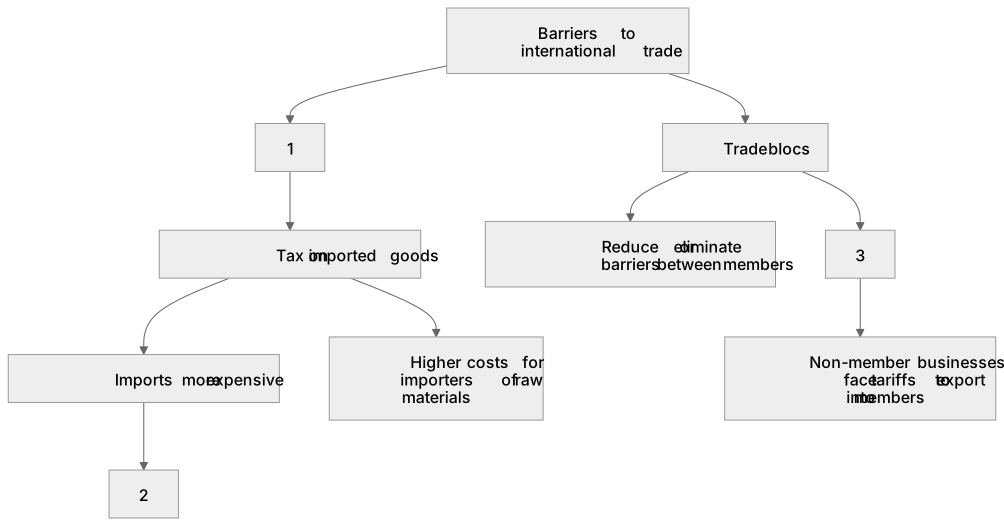
1Box 1
2Box 2
3Box 3
There is more to this lesson
The full lesson goes on to check your understanding and help you earn the marks. Create a free account to carry on, with your progress saved.
A week of Premium from your first lesson · Then the free plan continues · No card, no charge
Test your understanding of Business and globalisation: Barriers to international trade: ● tariffs ● trade blocs.
Active recall beats re-reading. Take an instant quiz now to test what you’ve learned and lock it into long-term memory.
A week of Premium from your first lesson · Then the free plan continues · No card, no charge